
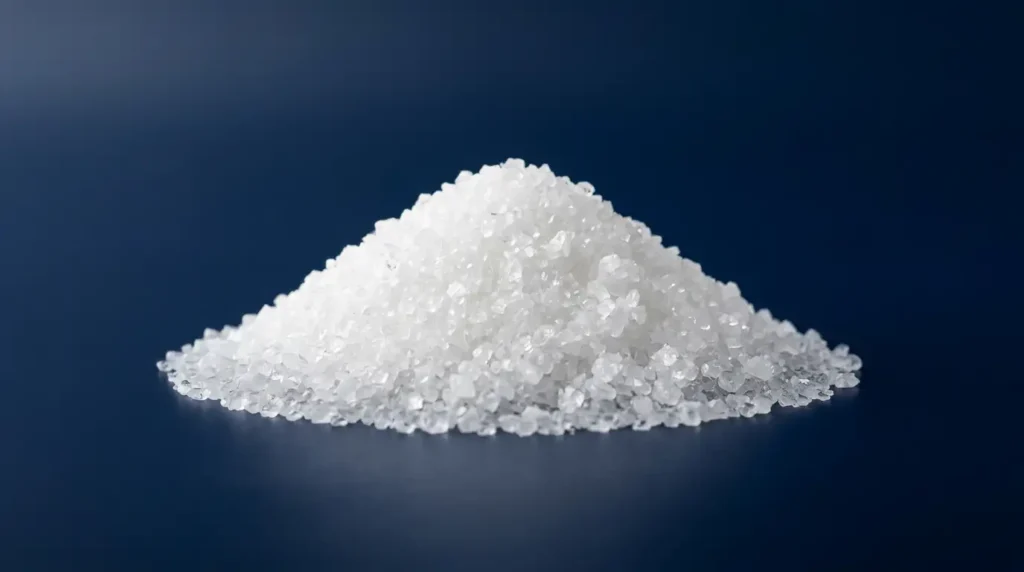

Magnesium sulfate

MgSO₄·7H₂O

10034-99-8
| # | Parameter | Standart |
|---|---|---|
| 1 | Appearance | White or almost white crystalline powder / colorless crystals |
| 2 | Assay (on dried basis) | 99.0–100.5% |
| 3 | pH (5% aqueous solution) | 5.0–8.0 |
| 4 | Solubility in water (20 °C) | Approx. 710 g/L |
| 5 | Water-insoluble matter, max | 0.01% |
| 6 | Chlorides (Cl⁻), max | 0.014% / 300 ppm |
| 7 | Loss on drying / ignition | 40.0–52.0% |
The present-day manufacture is based on raw material that can be used in a wide variety of industries because of its reliability. Magnesium sulphate is such a raw material. Whatever your goal is – be it increasing crop nutrition, development of medicines or provision of minerals needed for industrial formulae, this substance can help you in an efficient way.
As regards technical properties, it should be said that magnesium sulphate is a crystalline inorganic compound consisting of magnesium, sulfur, and oxygen. Sometimes, when it comes to industry documents, the substance is called by its abbreviation, which is mag sulph, or even magnesium sulfas on international scale. However, whatever name it is used under, the reliability and versatility of the substance will not disappear.
The commercial performance of Magnesium Sulphate depends largely on selecting the correct grade for the intended process. Different forms vary in moisture content, handling characteristics, and suitability for application, making product selection an important part of industrial procurement.
The most common commercial specifications include:
To preserve quality during storage, the material should remain in dry, sealed packaging protected from excessive humidity, since moisture absorption may affect handling performance over extended periods.
Magnesium Sulphate supports numerous industries because it contributes essential magnesium while remaining easy to incorporate into industrial formulations. Rather than serving a single purpose, it performs different functions depending on the production process.
Typical applications include:
Because different industries require different purity levels and particle sizes, selecting the appropriate grade directly influences production efficiency and final product consistency.
Choosing the appropriate supplier involves much more than comparing product specifications. Industrial buyers usually assess long-term consistency, logistics capabilities, and technical documentation alongside price.
Important evaluation criteria include:
Companies evaluating magnesium sulphate suppliers generally look for dependable supply continuity rather than occasional availability. Working with an experienced magnesium sulphate manufacturer also helps reduce operational risk, especially for continuous production. For larger operations, sourcing magnesium sulphate bulk quantities often improves inventory planning and transportation efficiency.
Industrial purchasing costs depend on several market variables rather than a single pricing indicator. Raw material availability, processing costs, transportation, exchange rates, packaging requirements, and international freight all contribute to procurement expenses.
Before purchasing, buyers typically compare:
Evaluating total procurement cost instead of unit price alone usually provides a more accurate picture of long-term operating expenses.
Magnesium Sulphate continues to play an important role across Brazilian agriculture, food production, pharmaceuticals, water treatment, and industrial manufacturing. Its versatility, dependable chemical characteristics, and availability in multiple grades make it a strategic raw material for companies seeking stable production and consistent quality.
Selecting the right supply partner is equally important. Reliable deliveries, technical consistency, and responsive customer support help manufacturers reduce operational risk and maintain uninterrupted production.
Foscote Group supplies Magnesium Sulphate and a comprehensive portfolio of industrial chemical raw materials to companies throughout Brazil. Through international sourcing expertise, dependable logistics, and rigorous quality standards, we support customers with solutions designed for long-term industrial success.

It is widely used in fertilizers, animal nutrition, pharmaceuticals, food processing, water treatment, and chemical manufacturing.
Hydrated grades contain water molecules within their crystal structure, while anhydrous material contains virtually no bound water, making it more suitable for moisture-sensitive applications.
It should be kept in sealed containers in a cool, dry environment to prevent moisture absorption and maintain consistent handling properties.
Raw material availability, production costs, transportation, packaging, purchase volume, and international logistics all contribute to market pricing.
Foscote Group combines reliable global sourcing, consistent quality, efficient logistics, flexible supply options, and technical support to help industrial customers maintain uninterrupted production.
Get in touch
with us!
We source products from reliable manufacturers across the globe and are always looking forward to connecting with new suppliers and customers.