
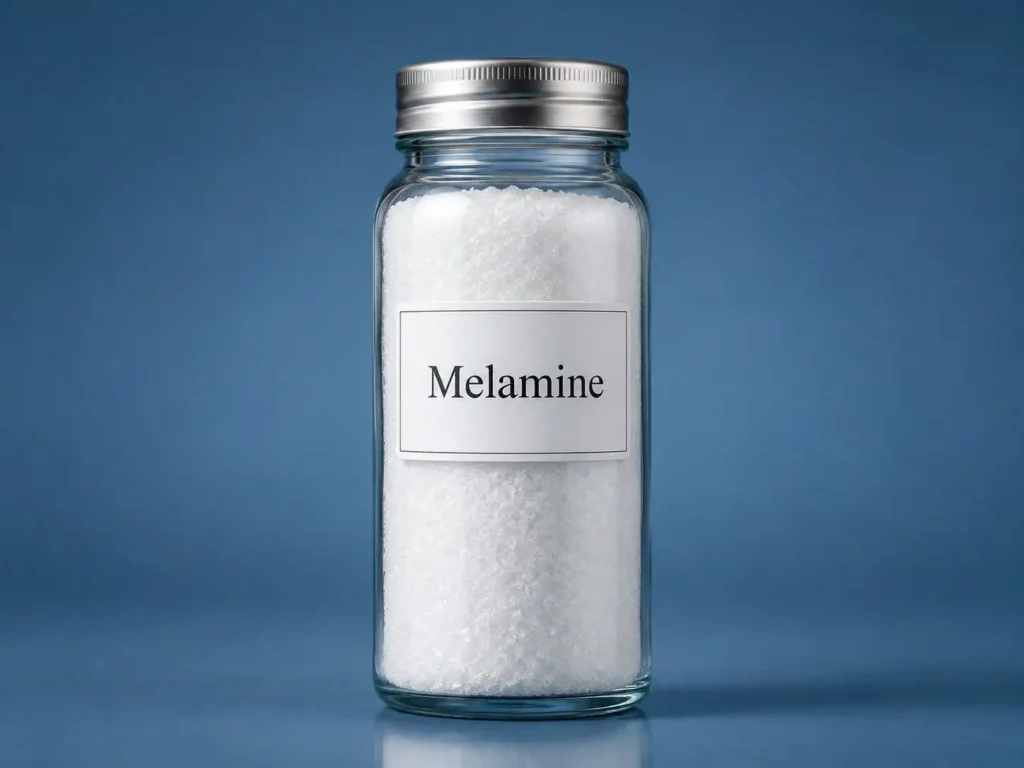

Melamine (1,3,5-Triazine-2,4,6-triamine)

C3H6N6

108-78-1

203-615-4
| # | Parameter | Standard |
|---|---|---|
| 1 | Appearance | White crystalline powder |
| 2 | Odor | Odorless |
| 3 | Solubility | Slightly soluble in water (3.24 g/L at 20°C) |
| 4 | Melting Point | ~343°C (decomposes) |
| 5 | Density | ~1.57 g/cm³ |
| 6 | Molecular Weight | 126.12 g/mol |
| 7 | Purity | ≥ 99.8% |
When people make panels, laminates, and surfaces that need to be strong, Melamine is not just something they add to improve the material. It is one of the components that helps make the final product durable and reliable. Companies that produce these materials need Melamine because it helps products resist heat, scratches, and moisture. In Brazil, Melamine is very important for making construction materials and furniture because it helps these products last longer and look good. As Brazil continues to build houses, roads, and other infrastructure, and as demand for furniture and interior products grows, the need for Melamine keeps increasing. This is because people want materials that are strong and will last a long time.
Melamine contains a high amount of nitrogen. Its molecules are arranged in a special way that gives it strength. This means it can withstand high temperatures and can be mixed with other substances to make strong materials. When Melamine is mixed with formaldehyde, it forms a material that keeps its shape when exposed to heat or pressure. Melamine in Brazil is useful because it can withstand heat and wear, does not get damaged in humid environments, and works well with other materials. These properties make Melamine suitable for products that need to last a long time, even if they are not very flexible.
Melamine is used in the production of thermosetting resins, especially when it is mixed with formaldehyde. These resins are used to make laminates, coatings, and wood products that need to be strong and resistant to chemicals. In Brazil, Melamine is used to make laminates for furniture and floors, coatings that can resist chemicals and abrasion, and adhesives for engineered wood panels. It is very important to get Melamine from a supplier that always provides consistent quality because small changes in Melamine can affect how the final product turns out.
Melamine usually comes in powder form, which makes it easy to measure and mix with other materials. However, the powder needs to be stored in a dry place because moisture can make it clump together and affect how it is processed. In factories, Melamine is often mixed with materials to make resins, distributed depending on what it is being used for, and processed at controlled temperatures. If Melamine powder has consistent particle size and purity, it is easier to use in manufacturing.
The demand for Melamine in Brazil comes from the construction, furniture-making, and coating industries, all of which need materials that are strong and look good. As these industries make products, they need to plan carefully to secure the Melamine they need. The price of Melamine in Brazil is affected by the urea market, energy costs, and transportation costs. Companies that want to buy Melamine in Brazil often try to make long-term agreements so they can secure a stable supply and price. Buying in bulk and working with the same supplier can help reduce costs and make planning easier.
Melamine powder must be stored in a cool, dry location in tightly sealed packaging to prevent moisture absorption and caking. It should be kept away from strong oxidizing agents and sources of ignition. Standard PPE — including dust masks, gloves, and eye protection — should be used when handling the powder. The SDS should be reviewed prior to use. Following proper storage and handling procedures maintains product quality from arrival through processing.
Melamine is an important material for making strong and durable products, especially in Brazil. Its role in producing resins and engineered materials makes it essential for many industries. Foscote Group is a supplier of Melamine in Brazil, and the company makes sure its clients always receive high-quality Melamine when they need it.
It is primarily used in resin production, laminates, coatings, and engineered wood products where durability and surface resistance are required.
It forms strong cross-linked structures that improve heat resistance, hardness, and chemical stability of the final material.
It is usually delivered as a crystalline powder, allowing precise dosing and easy integration into industrial processes.
Raw material costs, energy prices, and logistics all play a role in determining market pricing.
Yes, its chemical structure provides strong resistance to heat, making it ideal for thermosetting systems.
Get in touch
with us!
We source products from reliable manufacturers across the globe and are always looking forward to connecting with new suppliers and customers.